

Key Takeaways
True cost of car ownership
The true cost of car ownership is the total amount a vehicle costs you over time, including every expense beyond the loan or lease payment. It covers insurance, fuel, routine maintenance, tires, registration fees, repairs, and depreciation. Most drivers underestimate this figure significantly because they focus only on what they owe the lender each month.
Analysts typically calculate total ownership cost on a five-year basis, factoring in depreciation as a percentage of original purchase price alongside out-of-pocket cash expenses.
Why the monthly payment misleads most buyers
When a salesperson quotes a monthly payment, that number covers only the loan principal and interest. It leaves out every other recurring expense that follows you home from the dealership. Buyers who budget around that single figure routinely find themselves short within the first few months of ownership.
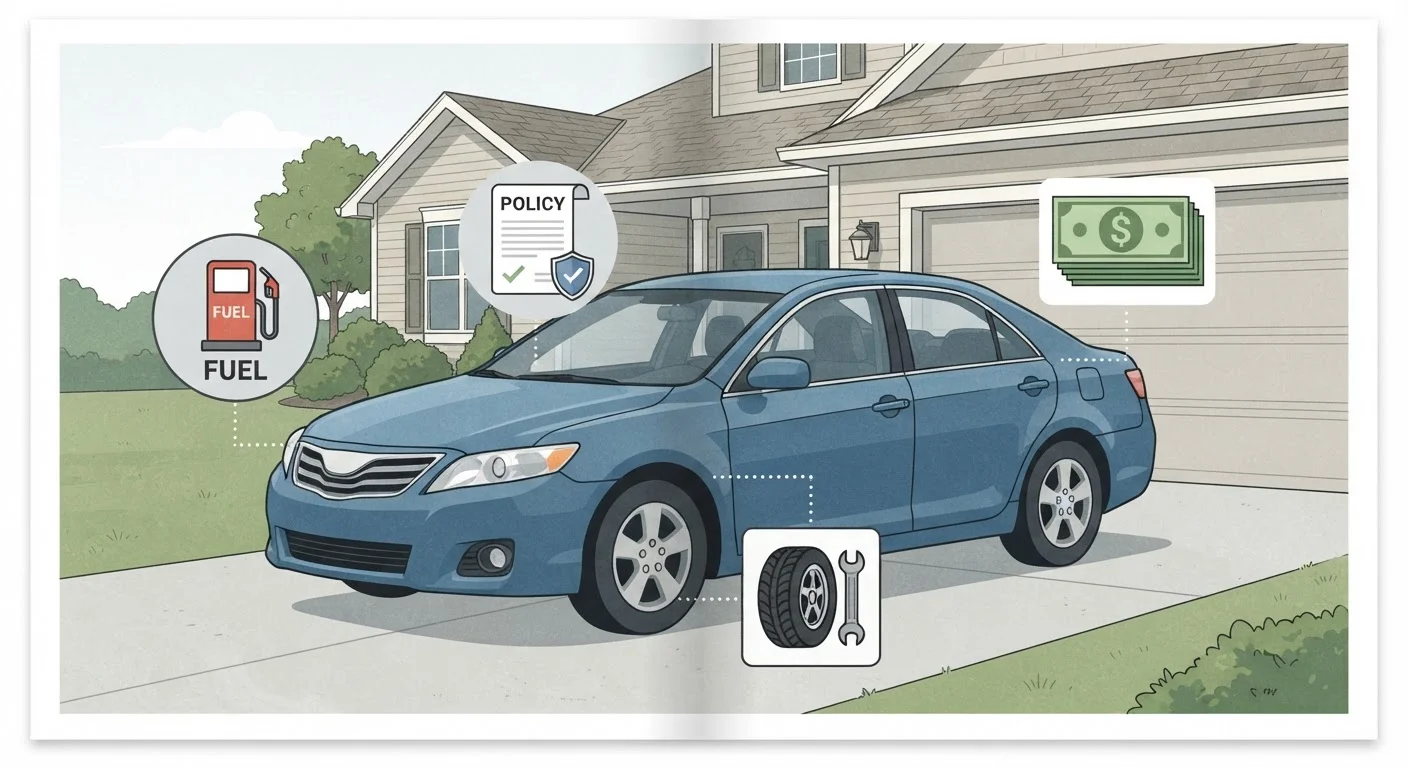
The true financial picture of buying a vehicle requires adding five additional cost categories to whatever you pay the lender: depreciation, insurance, fuel, maintenance and tires, and fees. Each one is predictable if you do the math before you commit.
Calculate total cost before you shop
Before visiting a dealership, estimate annual insurance, fuel, and maintenance costs for any vehicle you are considering. Use the EPA fuel economy database (fueleconomy.gov) for mpg figures and contact your insurer for a rate quote on the specific make and model. Adding those figures to the loan payment gives you a realistic monthly budget number.
Depreciation: the cost you never write a check for
Depreciation is the reduction in a vehicle's market value over time. You do not pay it monthly, but you absorb it every year you own the car and fully realize it when you sell or trade in. For a new vehicle priced at $35,000, losing 15 to 20 percent in year one translates to $5,250 to $7,000 of value gone before the first oil change is due.
Over five years, cumulative depreciation on many new vehicles can reach 50 to 60 percent of the original price. That figure dwarfs fuel and insurance costs for most drivers. Buying a vehicle that holds its value well, or purchasing a used model that has already passed through the steepest part of the depreciation curve, materially changes what the car ultimately costs you. See how long-term ownership spreads that depreciation cost across more years and lowers the annual hit.
Insurance, fuel, and the monthly costs that stack up
Auto insurance is a legal requirement in almost every state, and the premium depends on your location, driving record, coverage levels, vehicle type, and other factors. According to the National Association of Insurance Commissioners, the average US auto insurance expenditure has risen steadily in recent years, with many drivers paying $1,500 or more annually for full coverage. Drivers in high-cost states or with recent claims can pay considerably more. The factors that determine your insurance rate are worth understanding before you choose a vehicle, because a model with a high theft rate or expensive repair parts costs more to insure.
Fuel cost depends on three variables: how many miles you drive, local gas prices, and the vehicle's fuel economy rating. The EPA fuel economy estimate on the window sticker is a useful benchmark, but real-world consumption often differs. At 15,000 miles per year, a vehicle rated at 25 mpg costs roughly 600 gallons annually. At $3.50 per gallon, that is $2,100 per year before a single repair.
$10,000+
Average annual new vehicle ownership cost
AAA's annual 'Your Driving Costs' study consistently places total new vehicle ownership above $10,000 per year when all expense categories are included.
15-20%
Typical first-year depreciation rate
Automotive research organizations generally report that new vehicles lose 15 to 20 percent of their purchase price within the first 12 months of ownership.
50-60%
Five-year cumulative depreciation on new vehicles
Many new vehicles retain only 40 to 50 cents on the dollar after five years, according to general depreciation data tracked by automotive valuation services.
Maintenance, tires, and fees you can plan for
Routine maintenance covers oil changes, filters, brake fluid, and scheduled inspections. Most manufacturers publish a maintenance schedule in the owner's manual, and following it closely is the most direct way to prevent expensive repairs later. Tires are a separate line item that surprises many owners: a set of four replacement tires for a midsize sedan or SUV can run $400 to $900 installed, and tires typically need replacement every 40,000 to 60,000 miles depending on driving habits and tire grade.
Registration fees, state taxes, and local surcharges vary widely. Some states charge a flat annual fee under $100; others assess a fee tied to the vehicle's value that can exceed $500 per year on a newer model. These are predictable costs you can look up before purchase.
Unexpected repairs are harder to plan for but statistically certain over a long ownership period. A dedicated savings buffer, sometimes called an emergency vehicle fund, gives you a way to absorb a transmission repair or air conditioning failure without going into debt. The pattern of overlooked recurring costs in household budgets often includes vehicle-related line items that owners forget to account for month to month.
This article is for general informational and educational purposes only. It does not constitute financial, legal, or professional advice. Consult a qualified financial professional regarding decisions specific to your situation.