

Key Takeaways
Our Verdict
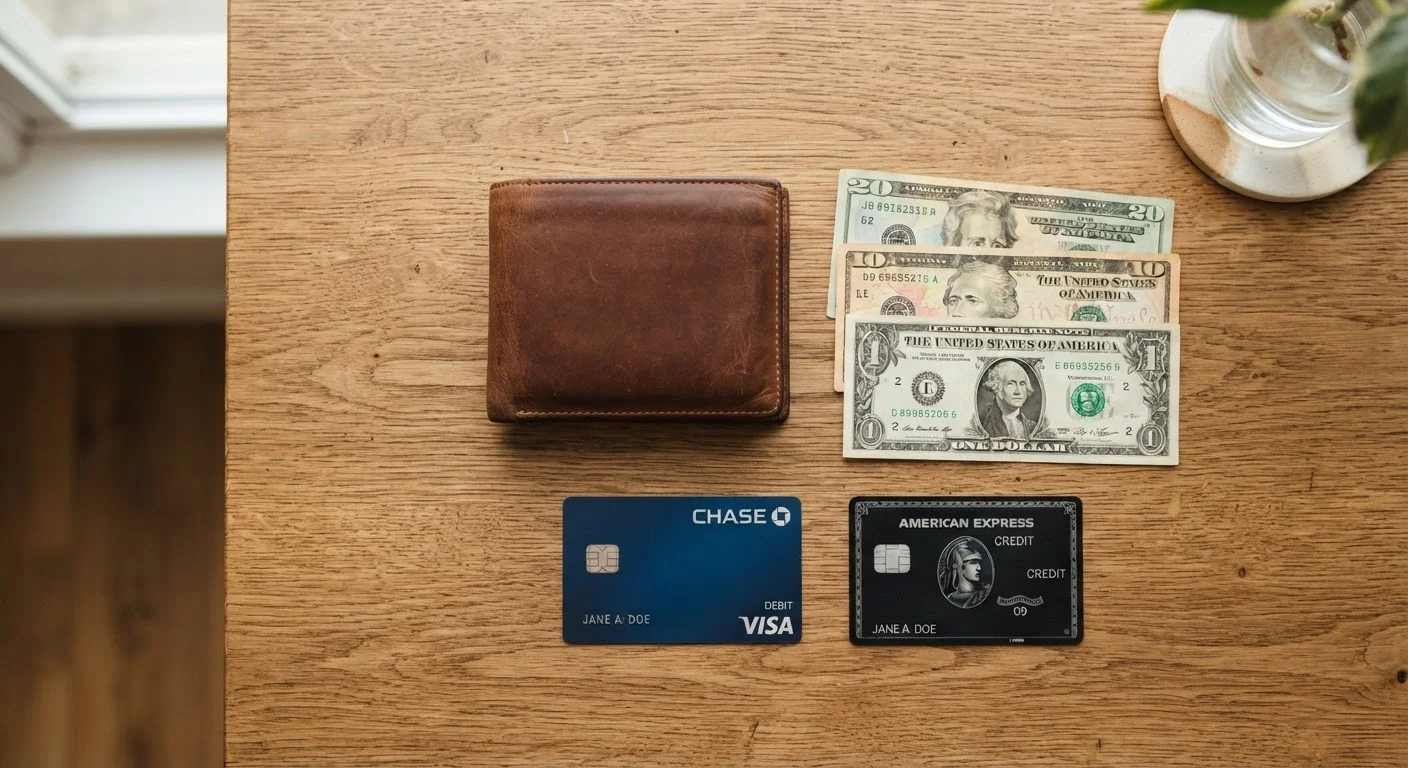
Each payment method has a specific role that depends on how a household manages money. Cash works well for discretionary categories where overspending is a recurring problem. Debit suits routine, fixed expenses when a budget is already tight and predictable. Credit makes the most sense when balances are paid in full each month and fraud protection matters, such as for online purchases or travel.
| Best for | Recommended |
|---|---|
| Households prone to discretionary overspending | Cash |
| Families with tight, predictable monthly budgets | Debit |
| Those who pay balances in full and want fraud protection | Credit |
| Online purchases and travel bookings | Credit |
What each method actually does to your money
Cash, debit, and credit all let you pay for things, but they touch your finances at different points and in different ways. Understanding those differences is more useful than picking a favorite.
Cash is a direct, immediate transfer of value. Once it leaves your hand, it is gone from your budget and gone from your protection. There is no transaction record, no dispute process, and no way to recover it if lost or stolen.
A debit card draws from money already in your checking account, usually within one business day. A transaction that exceeds your balance either declines or, if you have opted into overdraft coverage, triggers a fee. The Federal Deposit Insurance Corporation (FDIC) insures deposit accounts up to $250,000 per depositor, but that protects against bank failure, not fraud or errors on individual transactions.
A credit card creates a short-term loan. You spend now and pay later, either in full by the statement due date or in installments with interest added. Federal law under the Fair Credit Billing Act gives cardholders the right to dispute billing errors and unauthorized charges, and card networks often add zero-liability policies on top of that.
See where household money actually goes each month for context on how these payment methods fit into typical family spending patterns.
Fraud protection: a meaningful gap between methods
Federal protections for debit and credit cards differ in ways that matter when something goes wrong.
Under the Electronic Fund Transfer Act, your liability for unauthorized debit card charges depends on how quickly you report the problem. Report within two business days and your maximum liability is $50. Wait longer than 60 days after your statement is sent and you could be responsible for the full amount. The money is already gone from your account while the bank investigates, which can disrupt bill payments and other automatic withdrawals.
Credit card disputes under the Fair Credit Billing Act work differently. You report the unauthorized charge, the card issuer places a hold on the amount while investigating, and you are not paying interest on a charge you did not make. Your maximum liability for unauthorized use is $50 by law, and most major networks cap it at zero.
Cash has no federal protection at all. If your wallet is stolen, you have no claim to file.
| Cash | Debit | Credit | |
|---|---|---|---|
| Fraud protection | None | Limited (time-sensitive) | Strong (federal + network) |
| Spending limit | What you carry | Account balance | Credit line |
| Budget visibility | No digital record | Full transaction history | Full transaction history |
| Risk of debt | None | Overdraft fees possible | Interest if balance unpaid |
| Rewards potential | None | Rare and limited | Points, miles, cash back |
| Works for online purchases | No | Yes, weaker protection | Yes, strongest protection |
Spending behavior and budget control
Research in behavioral economics has consistently found that paying with cash tends to make purchases feel more real, which can reduce impulse spending. This is sometimes called the "pain of paying." For categories where a family tends to overspend, such as dining out or entertainment, using cash set aside in an envelope or designated pocket can act as a hard limit.
Debit cards sit in the middle. Spending still comes from your own money, so there is a natural ceiling, but the abstraction of swiping reduces the psychological friction that physical bills create. Overdraft fees can quietly add up if spending is not tracked carefully.
Credit cards remove the immediate spending ceiling entirely. That is useful when cash flow is uneven, but it also means the budget discipline has to come entirely from the cardholder. Families carrying a balance from month to month are paying interest rates that commonly run above 20 percent annually, which adds meaningfully to the cost of every purchase. Patterns around payment methods can be one factor in why some households struggle to get ahead financially.
Consider using more than one method
Many families find it practical to assign payment methods by category rather than picking one for everything. Cash for discretionary spending, a debit card for fixed predictable bills, and a credit card reserved for online purchases or travel can give you control where you need it and protection where it matters most. Track all three in one place so nothing falls through the gaps in your monthly review.
Rewards, records, and practical trade-offs
Credit cards are the only one of the three methods that can return value through rewards programs. Points, miles, and cash back are real, but they are worth less if a household carries a balance. Interest charges at current rates will outpace most rewards structures quickly. How loyalty programs work is worth reading before assuming travel rewards will offset spending costs.
For record-keeping, debit and credit cards both generate transaction histories that can connect directly to budgeting software or spreadsheets. Cash does not. Families working from a household budget may find that mixing cash with card spending creates gaps in their tracking.
For online purchases, cash is not an option, and debit cards carry the weaker fraud protection described above. Most consumer advocates recommend a credit card with a low limit for online transactions precisely because the dispute process is faster and your checking account stays untouched during any investigation.
This article is for general informational purposes only and does not constitute personalized financial or legal advice. Consult a qualified financial professional for guidance specific to your household's situation.